An IT park is not a factory. It is not a retail complex. It is a high-density environment where employees, contractors, vendors, delivery personnel, and visitors move through multiple controlled zones simultaneously — often across two or three shifts, 365 days a year. Generic security guard deployments consistently fail this environment because they are not designed for it.
The consequences of a security failure at an IT campus are not limited to property loss. They include data breach exposure, regulatory liability under IT Act provisions, client contract violations, and reputational damage that can affect employee recruitment. Security at a tech campus is a business risk function, not a facility cost line.
The Access Control Challenge at Scale
A mid-sized IT park with 5,000–10,000 employees across multiple buildings has dozens of entry and exit points, staggered shift timings, and a continuous flow of vendor vehicles, maintenance personnel, food delivery, and courier services. Managing this movement without a disciplined access control protocol creates invisible vulnerability — people who should not be in the building are inside, and no one knows.
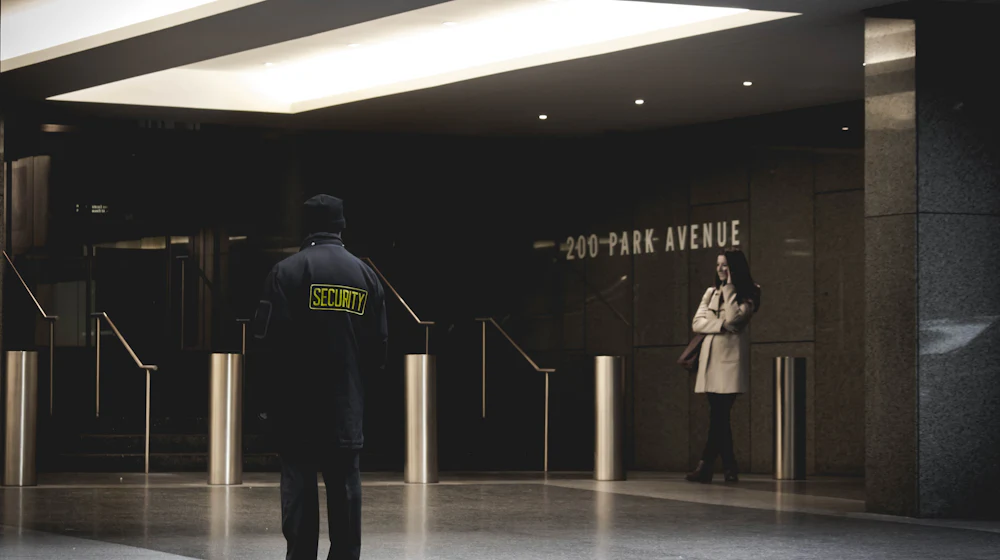
Professional campus security addresses this through a layered access model: perimeter guards controlling vehicle entry, lobby guards managing visitor registration and employee badge verification, and floor-level security personnel for restricted zones like server rooms, finance floors, and executive areas.
- All visitors must pre-register or be verified by a named employee host before entry
- Contractor and vendor access logged against a pre-approved vendor list with valid site induction records
- Vehicle entry managed through a separate lane with driver ID verification and vehicle log
- Temporary access passes issued with timed expiry and escort requirements for restricted zones
- Guard post handover documented with shift logbook — visitor count, incidents, pending access requests
Data Centre Physical Security: A Different Standard
The physical security of a data centre is governed by a stricter standard than the rest of the campus. Entry must be limited to authorised personnel only, with a two-factor verification approach — badge plus biometric or badge plus escort. Tailgating prevention is not optional; it requires a mantrap configuration or a dedicated access guard at every server room entry.
Guards deployed at data centre access points must be specifically briefed on the access control policy, trained to challenge any individual who attempts to enter without completing the verification protocol, and mandated to log every entry and exit with timestamp and personnel details. This log is an audit document that may be reviewed by internal compliance teams, clients, or regulators.
A security guard who admits an "authorised-looking" person into a server room without completing the verification protocol has not made a judgment call — they have created a security incident. Physical security of data infrastructure requires zero-exception protocols, not interpretation.
Visitor Management at Large Scale
At a tech campus with hundreds of visitors per day, manual visitor registers are both slow and unreliable. Professional campus security operations integrate with digital visitor management systems — guards verify and log visitors digitally, with automatic host notification, badge printing, and real-time visitor count visibility for the security operations centre.
The guard's role in this system is not data entry — it is identity verification and behavioural screening. Training guards to identify social engineering attempts, to notice individuals who seem unfamiliar with the campus layout, and to challenge politely but firmly when protocols are not met is a training investment that prevents the incidents that technology alone cannot.
Night Operations and After-Hours Security
IT campuses frequently operate 24/7, but the security risk profile changes significantly after business hours. During standard shifts, the volume of legitimate movement acts as a social deterrent. After hours, the campus is quieter, CCTV coverage becomes more critical, and unauthorized access attempts are more likely to go unnoticed without active patrol.
After-hours security requires: staggered patrol schedules with GPS verification, mandatory supervisor check-ins at defined intervals, a standing protocol for challenging any individual on the premises who cannot produce valid access credentials, and a direct escalation line to the QRT for any incident that a single guard cannot manage alone.
SLA Standards for IT Campus Deployments
- Guard-to-area ratio: typically 1 guard per 3–5 entry/exit points during peak hours, with reduced coverage on validated low-risk zones
- Incident reporting: preliminary report within 2 hours of any reportable event, final report within 24 hours
- Patrol frequency: perimeter patrol every 60–90 minutes during off-peak, every 45 minutes at night
- Visitor log accuracy: 100% of visitors logged with host name, ID type, entry/exit time
- Access violation response: guard at the scene within 3 minutes of any access alarm
- Supervisor on-site visit: minimum twice per week, unannounced, documented
Why Generic Security Deployments Fail IT Campuses
The most common failure mode is deploying experienced manufacturing or residential guards on a tech campus without site-specific training. The challenge is not physical — it is procedural. A guard who is excellent at perimeter patrol at a warehouse has no reference framework for managing a visitor tailgating incident at a server room entry, interpreting access control system alerts, or documenting a potential social engineering attempt.
Site induction — a structured briefing on the campus layout, access protocols, tenant-specific security policies, and escalation contacts — must precede deployment. Guards must be tested on their understanding before being posted. This is a non-negotiable quality standard that differentiates a professional security partner from a headcount supplier.